Unleashing Unconstrained Creativity: How Automated Workflows Eliminate Class Friction Points
For years, educators and creators have lived with a frustrating compromise: the gap between grand pedagogical vision and realistic operational bandwidth. We design ambitious curricula, imagining dynamic, immersive scenarios that place learners at the center of complex problem-solving. Yet, when faced with the grinding realities of production timelines, budget limitations, and technical hurdles, those vision boards inevitably shrink. We settle for what is manageable rather than what is truly transformative.
The Production Wall: A Case Study in Settling
Consider a standard 15-week academic semester meeting twice a week. To deliver an engaging, case-based learning environment, an instructor needs 30 distinct engagement scenarios. Ideally, each scenario would be a cinematic, interactive vignette—a rich narrative where students observe subtle human behaviors, evaluate complex contextual factors, and make high-stakes decisions.
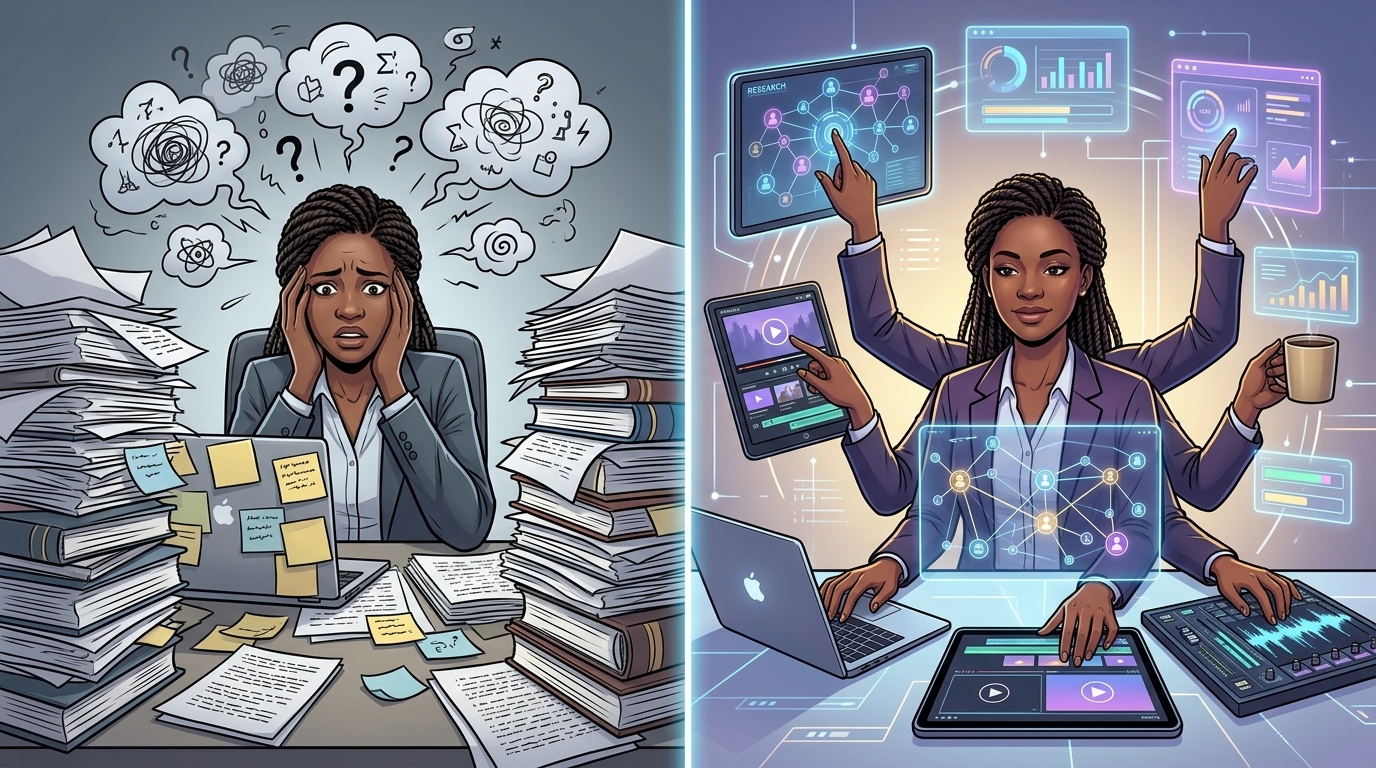
In a traditional production model, creating 30 custom videos requires scriptwriters, videographers, actors, sets, video editing software, and hundreds of hours of post-production. The resource cost is staggering. Faced with this wall, my own vision was forced to shrink: instead of cinematic scenarios, I ended up delivering a static slide and a brief paragraph per class. It conveyed the factual information, but it completely missed the immersive, experiential depth that brings complex social systems to life.
The New Stack: Mapping an Automated AI Workflow
Today, automated AI workflows eliminate these traditional friction points entirely. What once required a studio crew and a massive budget can now be orchestrated seamlessly by a single practitioner operating a refined technological stack:
- Verifiable Research & Structure: The foundation begins in Google NotebookLM, organizing evidence-based research, clinical literature, and curriculum standards into a grounded, searchable repository to ensure source integrity.
- Integrated Narrative Scripting: Google Gemini leverages that research base to generate multi-layered, nuanced scenario scripts complete with branching decision paths and character dialogue.
- Visual & Audio Production: Visual concepts are storyboarded using tools like Google Flow, animated with realistic character dynamics and voiceovers in Meta AI, and stitched together into polished, cinematic video vignettes.
- Interactive Choice Scoring: The final video assets are embedded into a custom web interface that uses lightweight logic scripting to evaluate student choices in real time, delivering individualized feedback and tailored learning trajectories based on their decisions.
What previously took months of production and tens of thousands of dollars is now accomplished in hours. The instructor shifts from being an overworked content producer to a high-level director of automated tools.
Redefining “Workflow” Beyond Institutional Walls
For a long time, many of us understood “workflow” as a passive term—merely staging tasks and managing production schedules. But when you reframe workflow as tool selection, integration, and continuous refinement, you enter a completely different race. Workflow is not just an administrative utility; it is the ultimate engine of creative leverage.
Furthermore, this capability is no longer locked inside traditional institutional walls. Free from bureaucratic constraints, creators and social entrepreneurs are applying these automated workflows across online courses, performance media, social media marketing, and virtual community platforms. We can now build sophisticated, adaptive learning environments directly for public audiences, professional networks, and global communities without asking permission from institutional gatekeepers.
Reclaiming Creative Audacity
The bottleneck to high-impact content is no longer technology, cost, or time. The primary limitation today is how boldly we allow ourselves to think.
If you have drawers, hard drives, or notebooks filled with brilliant ideas that you set aside because they were “too time-consuming to build” or “too complex to execute,” it is time to open them back up. You can now do more than you ever imagined. Reclaim the creative audacity that brought you into this work in the first place. Map your projects, refine your workflow stack, and build the cinematic, interactive experiences the world has been waiting for.

You may also like

The Algorithm is the Answer to Education