
The Alma Mater Advantage: How to Leverage Past Connections into Teaching Opportunities
Breaking into higher education instruction—whether aiming for an adjunct role or a full-time faculty position—often feels like shouting into an administrative void. Most applicants polish a generic CV, submit it to an unmanaged applicant tracking system, and adopt the passive posture of a supplicant waiting to be selected.
The lowest-hanging fruit in your academic job search isn’t buried in a cold job board; it is sitting in the department where you earned your degree. Your alma mater represents your most accessible launchpad to build authority and secure teaching roles.
Start with Guest Lectures, Not Full Courses
When connecting with your former university, don’t limit your focus to waiting for a full course section to open up. Higher education departments are notoriously risk-averse when hiring new instructors. Jumping straight to asking for a full course can create unnecessary administrative friction.
Instead, look for micro-opportunities. Scan your alma mater’s current course catalog and identify specific classes aligned with your current industry expertise. Reach out directly to former professors or current course directors with a clear, low-friction proposal: offer to deliver a specialized, 45-minute guest lecture or workshop.
A guest lecture acts as a live proof of concept. It allows faculty members to evaluate your teaching style, command of material, and student engagement without financial or administrative hurdles. You win friends within the department, solve an immediate instructional need for the professor, and establish immediate environmental authority.
Leverage Relationships into Hiring Committee Referrals
Once you have delivered value in the classroom and built genuine rapport with faculty, transition those connections into active advocacy.
When adjunct pools open or full-time search committees form, your faculty allies become your internal champions. Instead of your application entering a stack of anonymous resumes, your contacts can introduce you directly to the department chair or hiring committee members. You bypass the HR vacuum because institutional insiders can already vouch for your reliability and classroom execution.
Beyond the Intro: Deploying the DTEEE Framework
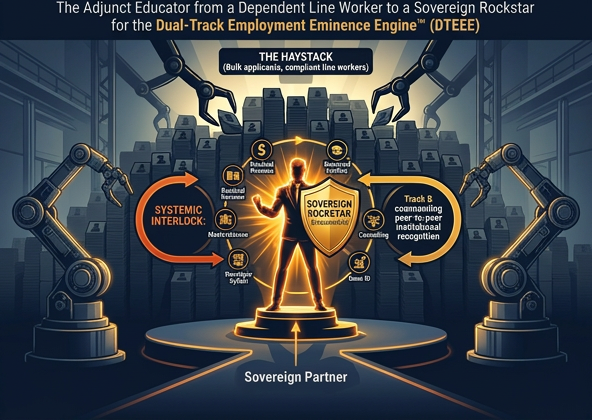
Relationships open the door, but your strategic positioning closes the deal. To move beyond being “a helpful alumni guest speaker” and become an indispensable faculty member, you must deploy The Dual-Track Employment Eminence Engine™ (DTEEE).
Grounded in Sovereign Choice Architecture, the DTEEE framework shifts your posture from a job seeker to a sovereign partner offering high-value institutional alignment. You execute this strategy across two parallel tracks:
- Track A: The Compliance Compendium (The Inside Game): Deliver pre-architected, accreditation-ready application assets—including a tailored CV, teaching philosophy, and ready-to-deploy syllabi—to eliminate administrative friction for HR and committee panels.
- Track B: The Sovereign Brand Engine (The Outside Game): Build your public digital footprint simultaneously. Maintain an authoritative website and share thought leadership on LinkedIn showcasing your domain expertise.
When search committee members research your name after a referral, Track B activates. Instead of finding a passive job seeker, they discover a visible subject matter expert. They immediately recognize they aren’t just filling a vacancy with a line worker—they are acquiring an industry rockstar.
Take Control of Your Academic Trajectory
Your alma mater is your built-in ecosystem for establishing immediate traction. Start by delivering value through guest lectures, cultivate internal advocates, and back it up with a sovereign digital brand.
To learn more about mastering the DTEEE framework and building your custom compliance compendium, check out the deep-dive articles and guides available on my blog and LinkedIn page.

You may also like

The Algorithm is the Answer to Education