The Adjunct Job Market Has Changed—Have You?
Why “Rockstars” Are Replacing “Line Workers” in Higher Education
By Dr. Michael A. Wright | ATCOExSEL Blog | edu.mawmedia.com
The adjunct job market is no longer what it was even five years ago. The days of submitting a curriculum vitae into an applicant tracking system and waiting patiently to be “selected” are rapidly fading. Institutions are overwhelmed with applications, and the traditional hiring process has become a numbers game that rarely serves anyone well—least of all the highly qualified scholar-practitioners who get lost in the shuffle.
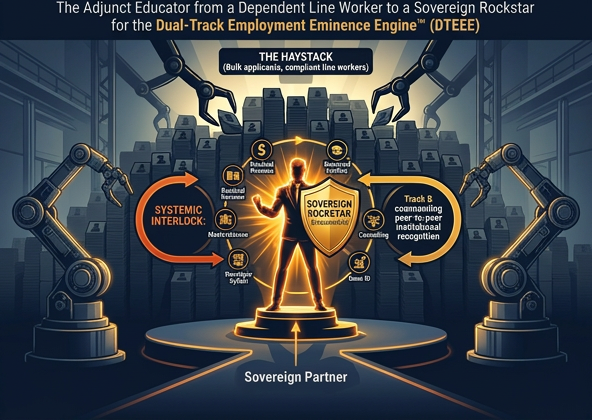
As I often say, “The job market moving forward will be more about rockstars than line workers. Not as a function of evolution, but as a function of the ability to find needles of the best fitting worker in haystacks of applicants.”
This is the foundation of what I call the Dual-Track Employment Eminence Engine™ (DTEEE)—a paradigm shift that transforms how adjunct faculty and academic professionals approach institutional alignment. The question is no longer how do I get hired? but rather how do I position myself so that institutions actively seek me out?
Understanding the New Landscape: Three Critical Competencies
If you want to thrive in this new market, you must demonstrate mastery in three emerging areas that hiring committees are actively—if sometimes unconsciously—evaluating.
1. AI-Awareness: Embrace It or Be Left Behind
Artificial intelligence is reshaping every corner of higher education, from how students complete assignments to how institutions assess learning outcomes. Adjuncts who demonstrate AI-awareness—not just familiarity, but strategic integration—signal to hiring committees that they are forward-thinking and adaptable.
This doesn’t mean you need to become a technologist. It means understanding how AI tools can enhance instruction, how to design assessments that account for AI assistance, and how to guide students in ethical AI use. When your application materials and public-facing content reflect this awareness, you immediately distinguish yourself from the bulk of applicants still operating in pre-AI frameworks.
2. Novel Instruction and Assessment: Beyond the Traditional Syllabus
Institutions are hungry for instructors who bring fresh pedagogical approaches. The factory model of education—standardized lectures, multiple-choice exams, and one-size-fits-all rubrics—is crumbling under the weight of its own inadequacy. AI has only accelerated this collapse by exposing how easily traditional assessments can be circumvented.
Position yourself as someone who designs authentic assessments—project-based learning, competency demonstrations, and real-world applications that cannot be easily replicated by a chatbot. When you can articulate a philosophy of instruction that emphasizes critical thinking, creativity, and applied knowledge, you become the “rockstar” institutions are searching for.
3. Online Teaching Best Practices: Your Digital Classroom Presence
The post-pandemic reality is clear: online and hybrid instruction are permanent features of higher education. Yet many adjuncts still treat online teaching as an afterthought—a lesser version of face-to-face instruction.
The sovereign professional understands that online teaching requires its own set of competencies: asynchronous engagement strategies, video presence, learning management system fluency, and community-building in digital spaces. Demonstrating mastery here—through your materials, your digital real estate, and your professional profile—tells institutions that you are ready to deliver excellence in any modality.
Stop Applying. Start Positioning.
The DTEEE framework teaches adjuncts to stop viewing themselves as workers seeking employment and instead step into their identity as independent, high-status partners offering competent, confident institutional alignment. This means building both a bulletproof Compliance Compendium for the inside game and a Sovereign Brand Engine for the outside game.
- Track A (The Compliance Compendium): You satisfy every institutional requirement with precision, supplying tailored CVs, teaching philosophies, and sample syllabi that meet bureaucratic expectations without friction.
- Track B (The Sovereign Brand Engine): You maintain an unassailable public footprint. When search committees trigger their Google Reflex to research your name, they encounter an established thought leader with clear intellectual property, signature masterclasses, and field-specific authority.
When a department chair searches your name after reviewing your application, what will they find? A LinkedIn profile with a few endorsements? Or a robust ecosystem of thought leadership that makes them realize they need you?
Your Next Step
I’m developing comprehensive resources to guide you through this transformation—including the forthcoming DTEEE text and online course arriving at edu.mawmedia.com. Sign up for a free account now to stay connected to calls, updates, and the support you need to thrive.
You are not alone in academia. It’s time to stop waiting to be chosen and start positioning yourself to be pursued.
Explore. Engage. Evolve.
Dr. Michael A. Wright is the Chief Executive Coach at eduMAW and originator of the Dual-Track Employment Eminence Engine™. Learn more at edu.mawmedia.com.

You may also like