The Algorithm is the Answer to Education
The ultimate objective of teaching can be stated simply: the job of teachers is to capture the attention, imagination, and effort of children. While most educators agree on this foundational imperative, consensus rapidly disintegrates when we ask how to achieve it. Progressive reformers insist we must “let students lead,” while institutional traditionalists point to rigid, non-negotiable academic standards.
For decades, education policy has treated these two goals as mutually exclusive. We either enforce standardization at the expense of student agency, or we grant autonomy at the expense of structured outcomes. But this is a false dichotomy. Adults and Subject Matter Experts (SMEs) can structure educational ecosystems in such a way that student self-direction inherently leads toward accomplishing standards.
The solution lies in combining behavioral economics and operational planning through what is termed the Sociocybernetic Control Model of Education (SCME). When engineered correctly, the ultimate operational system—”the algorithm”—becomes the catalyst for human excellence.
Beyond the Industrial Assembly Line
Traditional schooling remains trapped in an obsolete assembly-line paradigm. In an assembly-line model, standardized components move down a conveyor belt, and uniform processing is expected to produce identical outcomes. It assumes every student possesses the same cognitive shape, speed, and motivation. When students inevitably fail to fit this rigid structure, the system sorts them into a single-factor hierarchy of “smart” versus “dumb”. As sociocybernetic research highlights, this setup relies heavily on tick-box compliance and administrative oversight, which stifles individual talent and creates widespread alienation.
Instead of an assembly line, true education requires a control system model. A control system consists of four dynamic elements: inputs, the system itself, outputs, and feedback.
- Inputs require a choice between merely “dressing” a learner with institutional branding or “developing” them through cognitive growth and self-development.
- System dynamics separate the implicit learning environment (advising, culture, peer networks) from explicit classroom instruction.
- Outputs measure whether learners acquire the capacity to replicate excellence.
- Feedback determines whether student experience data is treated as useless waste or utilized for system renewal.
When an educational framework operates as a closed-loop control system, it adapts dynamically to the learner rather than forcing the learner to conform to a rigid machine.
Behavioral Economics and Choice Architecture
How do we allow students to lead while ensuring they hit rigorous standards? This is where behavioral economics enters the picture.
Human behavior is driven by choice architecture—the environmental context in which decisions are made. Rather than coercing students through heavy-handed authority, educators can use operational planning to construct pathways where the path of least resistance is also the path to competence].
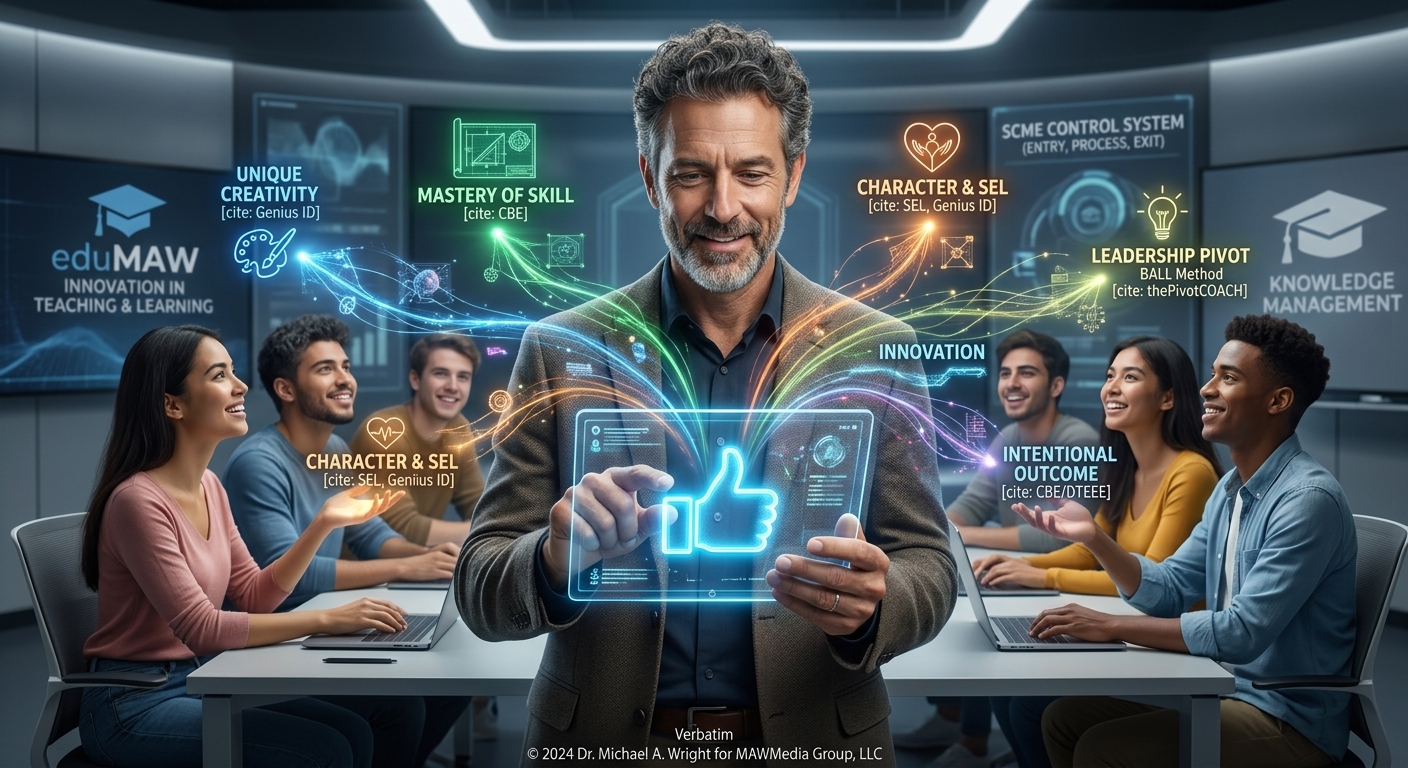
By introducing targeted micro-interventions, such as identifying a student’s unique Genius ID—their inherent creative capabilities and character strengths—we alter the internal incentive structure of the learner. When a student perceives that an educational activity aligns with their internal vision and identity, their engagement transforms from reluctant compliance into self-directed effort.
Operational planning packages educational standards into Competency-Based Education (CBE) units. Students aren’t asked to sit passively through fixed time intervals; instead, they navigate structured choices, scenarios, and skill challenges that demonstrate mastery. The adult SME defines the boundary conditions and standards, but the student controls the trajectory, pace, and execution.
The Sociocybernetic Control Model of Education (SCME)
This integration forms the core of the Sociocybernetic Control Model of Education. Sociocybernetics is the study of feedback loops within complex social systems. In a traditional classroom, student data (struggles, interests, pacing) is largely wasted—it becomes an uncaptured byproduct that results in frustration or dropouts.
In the SCME framework, every interaction feeds back into the system. Through structured tracking—incorporating coaching methodologies (such as the COACH Method), peer support networks, and experiential game planning—the system continuously readjusts. If a student encounters friction, the intervention redirects resources, adjusts advising, or provides targeted support.
This feedback loop converts operational data into system renewal. The institution learns how to better serve the student, and the student learns how to self-regulate and navigate complex environments.
“The Algorithm” as a Catalyst for Human Potential
When we say “the algorithm is the answer,” we are not advocating for cold, automated machines to replace human teachers. Rather, “the algorithm” represents the underlying operational logic, behavioral choice architecture, and sociocybernetic feedback mechanisms that govern the learning environment.
It is the personalized control system that continuously balances inputs and feedback to promote individual student genius. It captures student attention by honoring their autonomy, sparks imagination through tailored choice architecture, and harnesses effort by connecting academic standards to personal purpose.
When we replace the rigid industrial assembly line with an adaptive sociocybernetic framework, we no longer have to choose between standards and freedom. The algorithm manages the system, so educators can inspire the human.